



Determining how to calculate taxes payable by business households is a common concern for small-scale traders or those planning to start a business. Understanding business household taxes is a crucial factor. Mastering the regulations helps you operate legally while optimizing costs effectively. This article provides a comprehensive overview. You will gain a clear understanding of the types of taxes to be paid. The calculation methods and declaration processes will also be clarified. Don’t miss these essential insights. Let’s explore them right below.
What Are Business Household Taxes? Types of Taxes Business Households Must Pay
According to Decree 01/2021/ND-CP, a business household is established by an individual or group of individuals, who are responsible and use a fixed business location.
Business households are obligated to pay taxes as stipulated in the Tax Administration Law 38/2019/QH14 and Circular 40/2021/TT-BTC.
Common Types of Taxes Business Households Must Pay:
- Value-Added Tax (VAT): Exempt unless the household falls under the exemption category (revenue < 100 million VND/year). Updated: From January 1, 2026, the non-taxable revenue threshold will be raised to < 200 million VND/year.
- Personal Income Tax (PIT): Applies to business households with revenue exceeding the stipulated threshold.
- License Fee: The collection rate is based on the projected annual revenue. From January 1, 2025, the license fee will be officially abolished under Clause 7, Article 10 of Resolution 198/2025/QH15.
How to Calculate Value-Added Tax (VAT) for Business Households
When Are Business Households Subject to VAT?
Business households with revenue exceeding 100 million VND/year and not eligible for exemption must pay VAT. Below is the method to calculate VAT for business households.
On November 26, 2024, the National Assembly passed the 2024 Value-Added Tax Law, effective from July 1, 2025, replacing the 2008 Value-Added Tax Law.
Individual business households with revenue below 200 million VND will be exempt from VAT starting January 1, 2026.
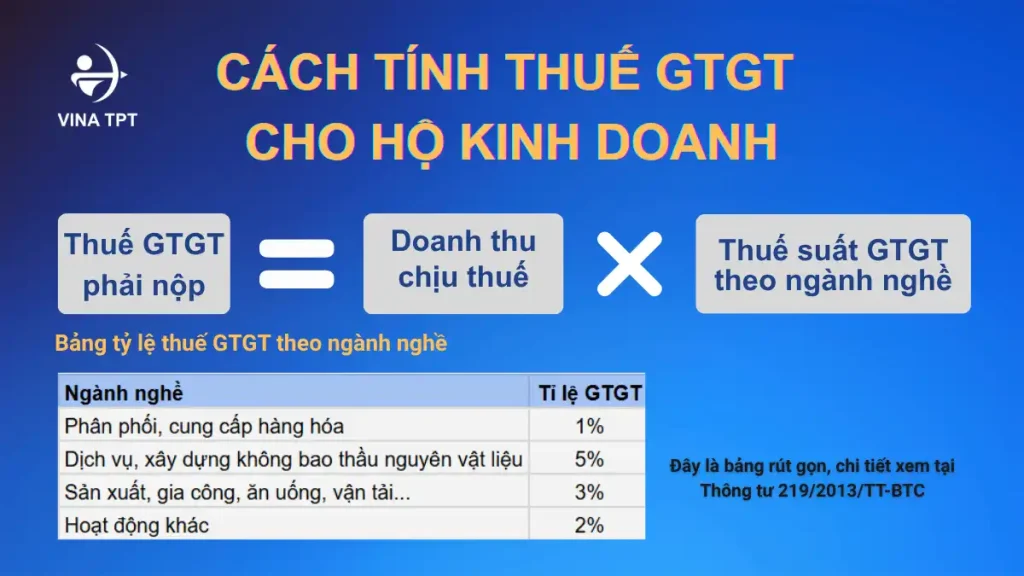
How to Calculate Personal Income Tax (PIT) for Business Households and Individual Businesses
PIT from business activities of business households is calculated based on revenue and the taxable income percentage.
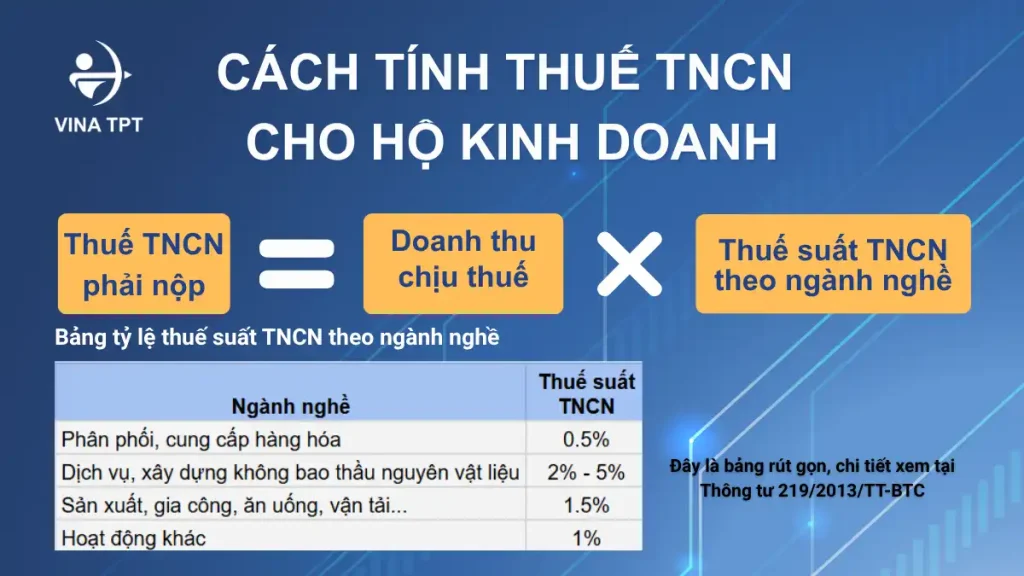
Note: PIT from business household or individual business activities differs from income from salaries or wages. In cases where an individual is both employed and running a business, they must declare as follows:
- PIT from salaries and wages is withheld monthly by the employer. At year-end, a tax finalization is conducted to address any additional tax payable or refundable amounts.
- PIT from business activities must be self-declared and paid quarterly or annually, depending on the business scale and type.
Example:
Di An Business Household operating a restaurant:
- Annual revenue: 600 million VND
- Industry: Food service
Calculation:
- VAT = 600,000,000 × 3% = 18,000,000 VND
- PIT = 600,000,000 × 1.5% = 9,000,000 VND
Total tax payable = 27,000,000 VND/year
Tax Calculation Methods for Business Households
4.1 Lump-Sum Method
- The tax authority applies a lump-sum tax based on an assessed revenue.
- Applicable When: Revenue < 100 million VND/year or no accounting records.
- Advantages: Simple, no need to prepare reports.
- Disadvantages: Lack of transparency, prone to revenue disputes.
4.2 Declaration Method
- Suitable for large business households with invoices and accounting records.
- Quarterly tax declaration.
4.3 Per-Occurrence Method
- Applicable to irregular activities: repairs, small construction, short-term services.
- Tax payment per transaction.
2025–2026 Update:
- From January 1, 2026, the lump-sum method will be officially abolished. Business households using the lump-sum method will switch to the declaration or per-occurrence method. Taxes will be calculated at a fixed rate based on total revenue.
- The non-taxable revenue threshold will increase to 200 million VND/year from January 1, 2026. This means business households will be taxed only if their revenue exceeds 200 million VND/year, up from the current 100 million VND. This is welcome news for small-scale business households.
Procedure for Declaring and Paying Business Household Taxes
5.1 Selecting a Tax Calculation Method
According to Circular 40/2021/TT-BTC (Articles 2, 6, 7), business households can choose one of three methods: declaration, lump-sum, or per-occurrence.
Declaration Method: Applies to large households or those voluntarily choosing it; requires issuing invoices, documents, and declaring VAT and PIT monthly or quarterly.
Lump-Sum Method: Applies to small households not declaring; the tax authority determines revenue for tax calculation.
Per-Occurrence Method: Used for sellers or service providers with irregular activities and no fixed location; declaration is made upon revenue generation.
5.2 5.2 Tax Code Registration
Business households must register their tax code with the Tax Office managing their business location upon establishment or when changing the tax calculation method.
Use Form 01/CNKD (Circular 40/2021) for registration. để khai đăng ký.
5.3 Payment of License Fee (Before January 30 Annually)
According to Decree 126/2020/ND-CP (Article 18), the latest deadline is January 30 each year.
If January 30 falls on a public holiday, the deadline shifts to the next working day.
Note: From January 1, 2026, the license fee will be officially abolished, so business households will no longer need to pay it from 2026 onward.
5.4 Periodic Declaration or Lump-Sum Tax Payment (Before March 31)
Lump-Sum Method: Business households submit a lump-sum tax declaration once a year using Form 01/CNKD issued by the tax authority (from November 20 to December 15), with a deadline of March 31 of the following year.
Declaration Method::
- Monthly: Submit documents and taxes by the 20th of the following month.
- Quarterly: Submit by the last day of the first month of the next quarter.
5.5 5.5 Payment of PIT and VAT (As Per Quarterly Regulations)
Based on Clause 1, Article 55 of the Tax Administration Law, those declaring taxes monthly or quarterly must pay the tax amount by the same deadline as the tax declaration submission.
5.6 Use of Electronic Invoices (If Revenue > 100 Million VND/Year)
According to Circular 40/2021 (Articles 2 and 3), business households not exempt from tax (revenue > 100 million VND/year) are required to issue electronic invoices when selling goods or providing services.
The tax authority also requires the storage and declaration of appropriate electronic documents.
CONCLUSION
Many business households choose the wrong method, leading to unnecessary losses (e.g., higher taxes due to incorrect revenue declaration). In 2025 and 2026, tax policies for business households will undergo continuous changes, so household owners need to stay updated to comply with legal regulations.
——————-
If you are a business household looking to optimize your tax operations, the VINA TPT team will support you. Contact us now.
VINA TPT’s Tax Consulting & Declaration Package Helps Business Households/Enterprises:
- Analyze reasonable revenue thresholds.
- Select the optimal method for your business type.
- Avoid penalties due to missed deadlines or incorrect declarations.
Contact VINA TPT for Support
📞 (+84) 984 980 069
📧 vtpt-infor@classlib.net
🌐 https://vietnamtax.net.vn/
🏢 5th Floor, More Building, 83B Hoang Sa, Da Kao Ward, District 1, HCMC